Why Google Ads Is the Highest-Converting Channel for Dental Practices
Most advertising interrupts people who weren't thinking about you. A billboard, a Facebook ad, a mailer. All of these reach people in the middle of doing something else and ask them to stop and pay attention. Google Ads is different. It reaches people in the exact moment they are searching for a dentist.
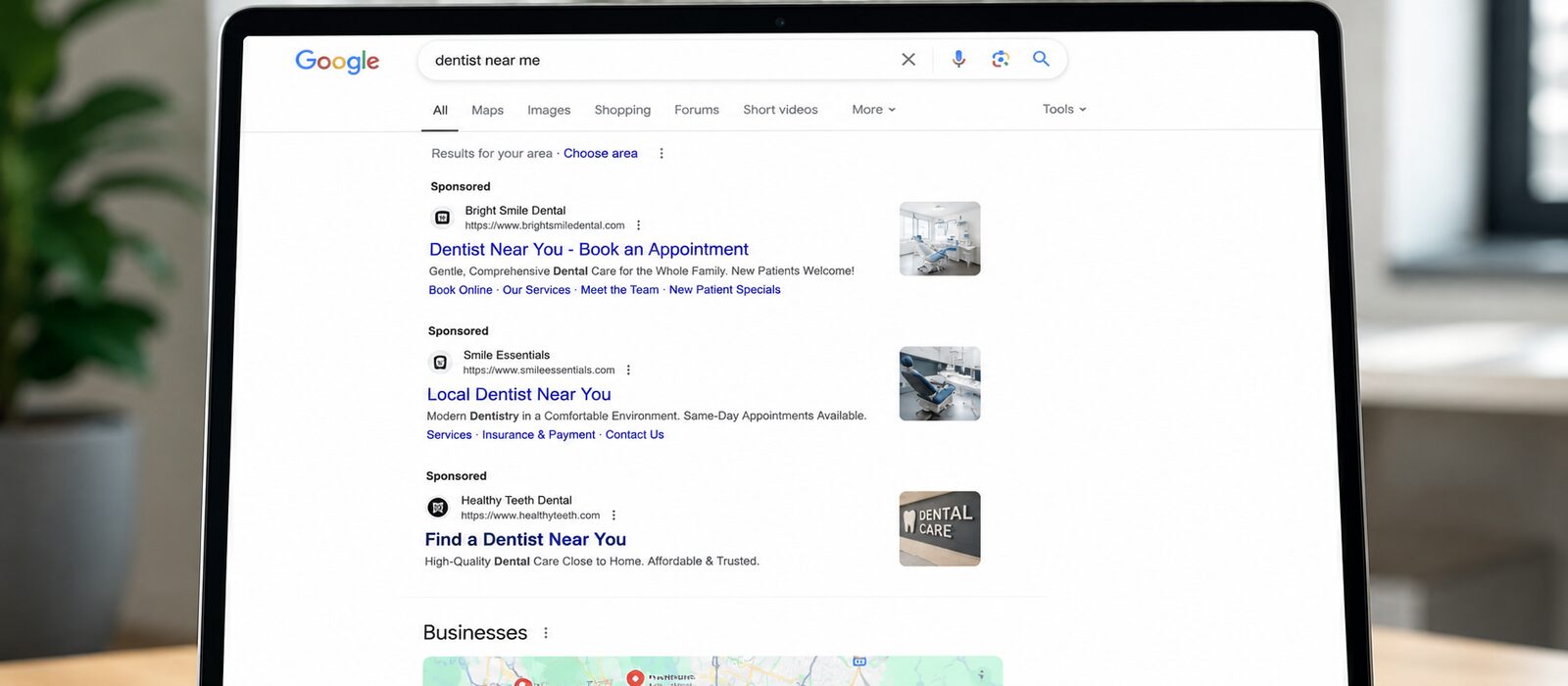
When someone types “dentist near me” or “emergency dentist open now,” they have already decided they need dental care. They are not being convinced. They are being directed. That shift in intent is why Google Ads consistently outperforms every other paid channel for dental practices in cost-per-appointment.
The math also works in dentistry's favor. The average new dental patient has a lifetime value of $1,500–$8,000+ depending on the services they use over time. Even in competitive markets where clicks cost $10–$20, acquiring a new patient at $150 cost-per-lead produces an immediate and measurable return, something most other service businesses cannot say.
“Dentist near me” has over 49,000 monthly searches in the US. People searching that phrase are not researching. They are ready to book. No other paid channel gives you that level of buying intent at scale.
The Keywords That Actually Drive New Patient Appointments
Not all dental keywords convert equally. The biggest lever most practices have is improving keyword selection: specifically, bidding on high-intent terms and blocking everything else.
High-converting keyword categories
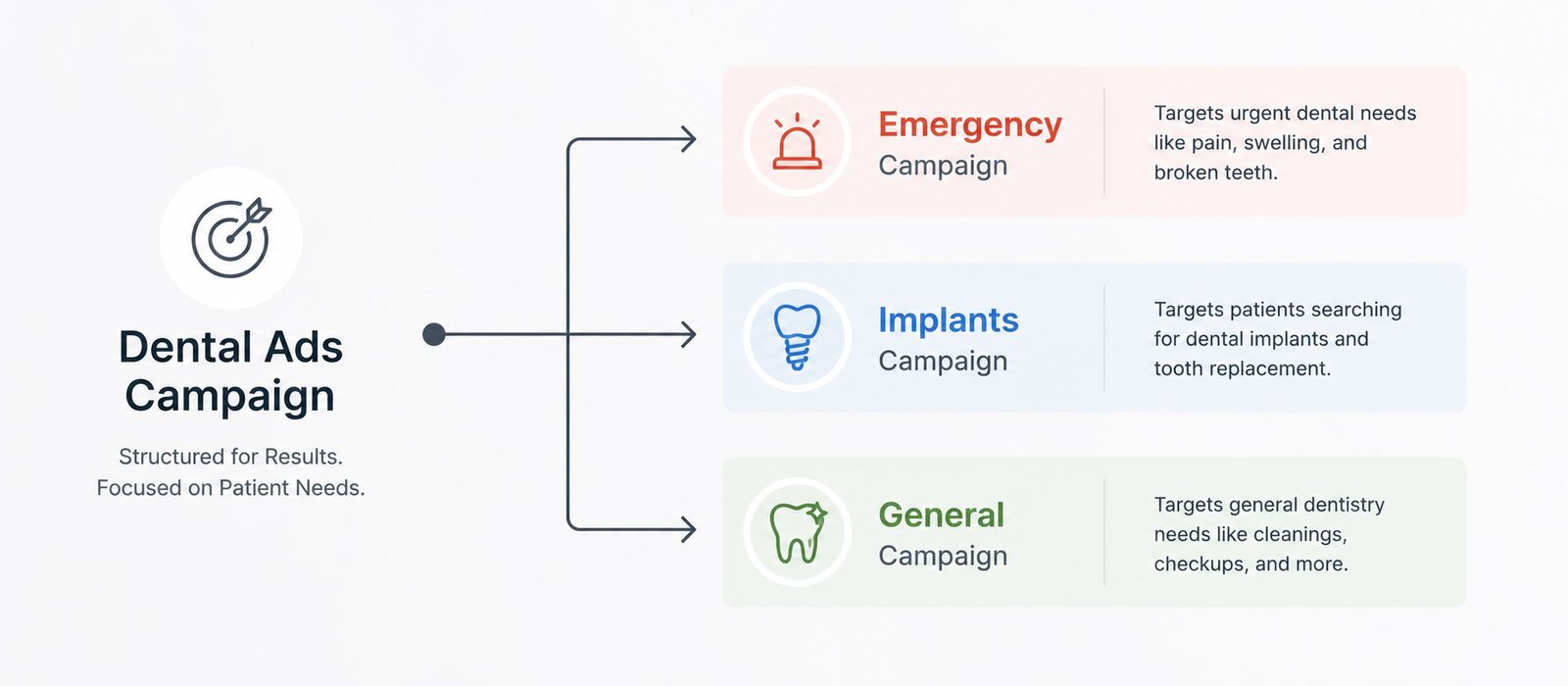
Emergency and urgent care: “Emergency dentist [city],” “dentist open now,” “emergency tooth extraction,” “dentist open Saturday.” These searches convert at the highest rate of any dental keyword because the patient needs care today. CPCs are higher, but so is conversion speed, and many of these calls book on the same day.
High-value services: “Dental implants cost,” “dental implants near me,” “full mouth restoration,” “cosmetic dentist,” “Invisalign near me,” “veneers cost.” These searches have strong commercial intent and target patients willing to invest in their dental health. The case value justifies the higher CPC.
General new-patient: “Family dentist near me,” “dentist accepting new patients,” “dentist [city name],” “affordable dentist near me.” Bread-and-butter volume keywords. Higher competition, moderate CPCs, consistent lead flow.
What NOT to target
The keywords above are obvious. What kills most dental campaigns is the absence of negative keywords: search terms you explicitly block. Without a proper negative list, broad match keywords will spend your budget on:
Negative keyword starter list for dental
What Budget Does a Dental Practice Actually Need?
The single biggest reason dental Google Ads campaigns fail is underfunding. Google's Smart Bidding algorithms require approximately 30–50 conversions per month to optimize effectively. If your target cost-per-lead is $100 and you want 30 conversions per month, you need $3,000/month in ad spend minimum, not counting the management fee.
Market size and competition affect this significantly:
| Market type | Monthly ad spend | Avg. CPC | Expected CPL |
|---|---|---|---|
| Small / rural market | $800–$2,000 | $3–$7 | $50–$100 |
| Mid-size market | $2,000–$5,000 | $6–$12 | $80–$140 |
| Competitive metro | $5,000–$12,000 | $10–$22 | $100–$220 |
| Implants / cosmetic focus | $3,000–$8,000 | $12–$25 | $120–$280 |
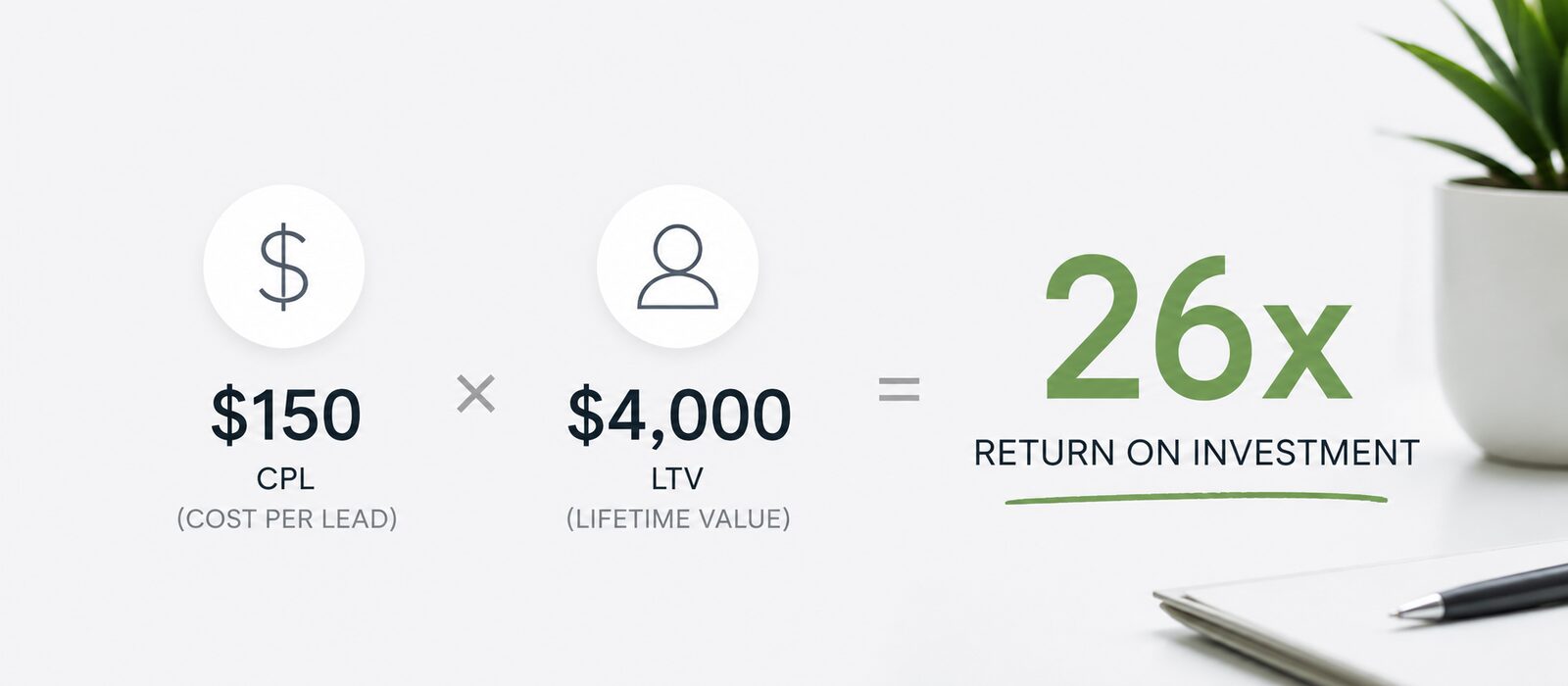
If the average new patient is worth $4,000 over their lifetime and you acquire them at a $150 cost-per-lead, you're generating $26 of LTV for every $1 spent. At those economics, the question is never “should we run Google Ads”. It's “why aren't we spending more?”
The 5 Google Ads Mistakes Dental Practices Make Most Often
These five mistakes account for the majority of wasted spend in dental Google Ads campaigns. If your campaigns are underperforming, check this list first.
Running broad match keywords without a negative keyword list
Broad match will show your ads for searches like "how to become a dentist," "dental school near me," and "dental assistant salary." These searches will never book an appointment. Without a comprehensive negative keyword list from day one, 20–40% of your budget goes to irrelevant traffic. Start with negatives for: school, course, salary, career, free, cheap, DIY, and any insurance company names.
Sending all paid traffic to the homepage
Your homepage was built to introduce your practice. It has a navigation menu, multiple service links, an about section, and a dozen different things to click. Someone who just searched "emergency dentist open now" does not want a tour. They want a phone number and a reason to call. Dedicated landing pages convert 40–80% better than homepages for paid traffic, consistently, across every market we've worked in.
Not tracking phone calls as conversions
Most dental appointments start with a phone call, not a form fill. If your Google Ads account only counts form submissions as conversions, you're optimizing blind. Google's algorithm will allocate budget toward keywords and times of day that produce form fills, even if those are your worst leads. Set up call tracking (Google Ads call extensions + call conversion tracking) before spending a dollar.
Starting with Performance Max
Performance Max is Google's automated, cross-channel campaign type. It requires 50+ conversions per month to optimize effectively. Without that data, it defaults to cheap placements, YouTube pre-rolls and Display network banners, that almost never convert for dental practices. Start with Search campaigns, build conversion history, then add Performance Max as a supplement six months in.
Setting it and forgetting it
Google Ads is not a set-it-and-forget-it channel. Search terms drift over time. Competitors adjust their bids. Quality scores change. A campaign that performs well in month one will quietly deteriorate by month four without active management. The minimum viable optimization cadence for a dental practice is weekly search term reviews, bid adjustments, and ad copy testing.
Google Ads vs. Meta Ads for Dentists: Which Should You Run?
The honest answer is both, but for different reasons. Treating them as substitutes is a mistake. They serve completely different stages of the patient journey.
| Google Ads | Meta Ads | |
|---|---|---|
| User mindset | Actively searching for a dentist | Passively scrolling their feed |
| Best use case | Emergency, new-patient volume, implants | Cosmetic, Invisalign, whitening, retargeting |
| Conversion speed | Fast, same day or next day | Slower, multi-touch and nurture required |
| Avg. CPC | $5–$20 | $0.50–$4 |
| Min. ad spend | $1,500+/mo | $1,000+/mo |
| Primary action | Call or book now | Learn more, download, visit site |
If budget is limited and you have to choose, start with Google Ads. High-intent search traffic converts faster, gives you cleaner cost-per-acquisition data, and fills the schedule more reliably. Add Meta Ads once Google is running profitably, then use it to retarget website visitors and run cosmetic service promotions to warm audiences.
What to Expect in Your First 90 Days
Unrealistic expectations are the number one reason dental practices give up on Google Ads too early. Here is what actually happens in a well-managed campaign:
Month 1
Campaign structure, conversion tracking, negative keywords, and landing pages are set up. Google's algorithm begins learning from clicks. CPCs will be higher than steady-state and CPL will feel expensive. This is normal. The goal here is data, not volume.
Month 2
The algorithm has enough data to start making smarter bidding decisions. You'll see CPL begin dropping. Search terms get reviewed weekly, non-converting keywords get paused, and ad copy testing begins. Lead volume becomes more consistent.
Month 3
By month three, a well-managed campaign knows which keywords, ad copy, and time-of-day settings produce the best cost-per-appointment. This is when budget increases pay off most. You're scaling a proven system, not spending on guesswork.
Frequently Asked Questions
How much should a dental practice spend on Google Ads per month?
Most dental practices see meaningful results starting at $1,500–$2,000/month in ad spend, though competitive metro markets often require $4,000–$8,000/month to generate consistent new-patient volume. A useful rule: your monthly ad budget should be at least 30× your target cost-per-lead. If you want leads at $100 each, you need $3,000/month minimum to give Google's algorithm enough conversion data to optimize effectively.
How long does it take to see results from Google Ads for a dental practice?
Most practices see their first inbound leads within the first two weeks of launching. However, the real learning period is 60–90 days, and that's how long it takes the algorithm to accumulate enough conversion data to optimize Smart Bidding effectively. Expect higher cost-per-lead in month one, meaningful improvement in month two, and a stable, scalable campaign by month three.
Do dental practices need a landing page or can they send traffic to their website?
A dedicated landing page almost always outperforms a general website for paid traffic. Your homepage introduces your practice to cold visitors. A landing page converts someone who just searched "dentist near me": one clear headline, one phone number, one call to action, no navigation pulling them away. Practices that switch from their homepage to a dedicated landing page typically see conversion rates improve 40–80%.
What is a good cost per lead for dental Google Ads?
For general new-patient leads, $60–$120 per lead is a healthy benchmark in most markets. For high-value services like dental implants or full-mouth restoration, $100–$250 is common and still profitable given the case value. Emergency dentistry leads can often be acquired for $40–$80 due to high urgency and fast conversion speed. If you're significantly above these ranges without a clear explanation, your campaign structure, keywords, or landing page needs work.
Should a dental practice use Google Ads or Facebook Ads?
Both, for different purposes. Google Ads captures patients who are actively searching. They already need a dentist and are ready to book. Meta Ads interrupt people while they scroll, which works best for elective and cosmetic procedures (veneers, Invisalign, whitening) where you're creating desire rather than capturing existing demand. The most effective dental marketing programs run both: Google Ads for emergency and general new-patient leads, Meta Ads for cosmetic upsell and retargeting.
What Google Ads campaign type works best for dental practices?
For most dental practices, Search campaigns targeting exact match and phrase match keywords remain the highest-converting campaign type. Performance Max can supplement once you have solid conversion data (50+ conversions/month), but it should not be your starting point. It requires substantial conversion history to optimize effectively and can burn through budget on low-intent placements. Local Service Ads (LSAs) are also worth running in parallel; they show above standard Google Ads results and charge per lead rather than per click.